Benefits of Full Stack Development for Modern Businesses
11 May 2026
Modern businesses need to deliver fast, reliable, and smooth digital experiences to stay competitive. Customers expect applications to work seamlessly across devices, and companies that cannot meet these expectations often fall behind. Full stack development has become a popular approach because it brings together frontend, backend, and deployment, allowing a single team to manage the entire product more efficiently.
This approach helps businesses build applications faster, reduce costs, and maintain better consistency across the system. According to Grand View Research , the web application development market is growing steadily due to increasing demand for scalable and cloud-ready solutions. From startups to large enterprises, companies are adopting full stack development to create products that are flexible, efficient, and ready to scale. Full stack development benefits are widely recognised in modern software development.
What is Full Stack Development?
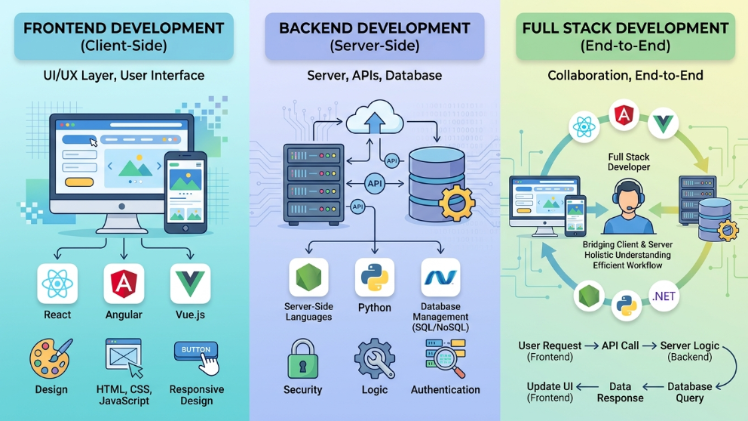
Full stack development covers everything required to build a complete web application, including the frontend interface, backend systems, databases, APIs, and deployment workflows.
A full stack team works across both frontend and backend development, enabling better collaboration, faster delivery, and more consistent application architecture.
Understanding Frontend Development
Frontend development focuses on the visual and interactive side of an application. Technologies such as React, Angular, and Vue.js are commonly used to build responsive, user-friendly interfaces.
Understanding Backend Development
Backend development manages server operations, business logic, APIs, authentication, and database interactions. Popular backend technologies include Node.js, Python, .NET, and Ruby on Rails.
What Makes Full Stack Development Different?
full stack development combines frontend and backend expertise within a single development workflow. This helps businesses reduce communication gaps, speed up development cycles, and maintain better consistency across the application.
Frontend vs Backend vs Full Stack
| Area | Frontend | Backend | Full Stack |
|---|---|---|---|
| Focus | UI/UX layer | Server, APIs, databases | Both layers combined |
| Technologies | React, Angular, Vue.js | Node.js, Python, .NET | A combination of both |
| Project Involvement | Partial | Partial | End-to-end |
| Best Suited For | Design-heavy interfaces | API or data-heavy systems | Startups, MVPs, SaaS, enterprise apps |
Key Benefits of Full Stack Development for Businesses
The advantages of full stack development make it a preferred choice for modern digital products.
1. Faster Development Process
When one team manages both frontend and backend development, communication becomes more efficient, and integration delays are reduced. This helps businesses launch products and updates faster.
2. Cost-Effective Development
Managing separate frontend and backend teams can increase operational and coordination costs. Full stack development streamlines collaboration, helping businesses optimise resources while maintaining quality.
3. Improved Flexibility
Business requirements often evolve during development. Full stack teams can manage updates across multiple layers of the application more efficiently, helping projects remain agile and adaptable.
4. Better Scalability
Full stack applications are designed with overall architecture in mind, making it easier to scale systems as user demand and business requirements grow.
5. Easier Maintenance and Support
Because the same team understands the complete application, troubleshooting, updates, and long-term maintenance become more efficient.
Overall, the advantages of full stack development include faster development, better scalability, greater cost efficiency, and easier application management for businesses.
Technologies Used in Full Stack Development
- Frontend: React, Angular, Vue.js
- Backend: Node.js, .NET, Python , Ruby on Rails
- Databases: MySQL, PostgreSQL, MongoDB
- Cloud & DevOps: AWS, Azure, Docker, Kubernetes
Choosing the right technology stack depends on business goals, scalability requirements, and long-term maintenance plans.
When Should Businesses Choose Full Stack Development?
Full stack development is ideal for:
- Startup MVP development
- SaaS platforms
- Enterprise web applications
- E-commerce platforms
- Cloud-based applications
Businesses seeking scalability, flexibility, and faster development cycles often benefit most from a full stack approach.
How Vedx Solutions Helps Businesses with Full Stack Development
Vedx Solutions provides end-to-end full stack development services tailored to modern business requirements. Our team works across frontend technologies, backend frameworks, databases, and cloud infrastructure to build scalable and high-performing applications.
Whether you are developing a SaaS platform, enterprise solution, healthcare application, fintech product, or e-commerce platform, Vedx Solutions delivers custom full stack solutions aligned with your business goals.
From project planning to deployment and long-term support, we focus on building reliable, secure, and scalable applications that support business growth.
Conclusion
The benefits of full stack development go beyond cost savings. It helps businesses build scalable, flexible, and high-performing applications while improving development speed and operational efficiency.
By combining frontend and backend development within a unified workflow, businesses can reduce complexity, accelerate product delivery, and adapt more effectively to changing market demands.
At Vedx Solutions , we help businesses leverage modern full stack technologies to build custom digital solutions designed for long-term growth and performance.
Search
Categories
24
1
4
7
12
Frequently Asked Questions
Is full stack development suitable for startups?
Yes. Full stack development enables startups to build and launch products faster without managing separate frontend and backend teams.
Which technologies are used in full stack development?
Common technologies include React, Angular, Vue.js, Node.js, Python, .NET, MySQL, PostgreSQL, MongoDB, AWS, Azure, Docker, and Kubernetes.
Why do businesses choose full stack development?
Businesses choose full stack development because it improves collaboration, reduces development complexity, and supports scalable application development.
How long does it take to develop a full stack application?
Development time depends on project size and features, but full stack development usually speeds up delivery by using a single team for frontend and backend.
Summarize With AI
Full stack development boosts scalability, speed, and business efficiency.
Let Vedx Solution be your trusted tech partner to build fast, reliable solutions tailored to your needs.
Related Blogs
03 Sept 2026